
HumanStandard now reads C2PA Content Credentials
Every file you send us is checked for Content Credentials before detection runs. When the tool that made a song signed it, the result shows that signature.
What Content Credentials are
C2PA is an open standard for attaching a signed record to a media file. The record says which tool made the file, when, and whether it was generated with AI. Suno and ElevenLabs both sign the audio they export. The signature is tied to the file's contents, so an edit made after signing breaks it.
What changes in your results
Uploads and audio file URLs are checked for credentials first. A file that carries them gets one of three readings:
- Verified
- The signature checks out against a trusted signer and the audio has not changed since it was signed. When a known AI generator declares the track AI-generated, that declaration is the verdict, and the report names the generator and model version, for example Suno v6.
- Unverified
- Credentials are present, but the signer cannot be confirmed, for example because its certificate has expired. We show what the credentials claim and run full detection.
- Altered
- The audio or the declaration changed after signing. We flag the file and run full detection.
Files without credentials are checked exactly as before.
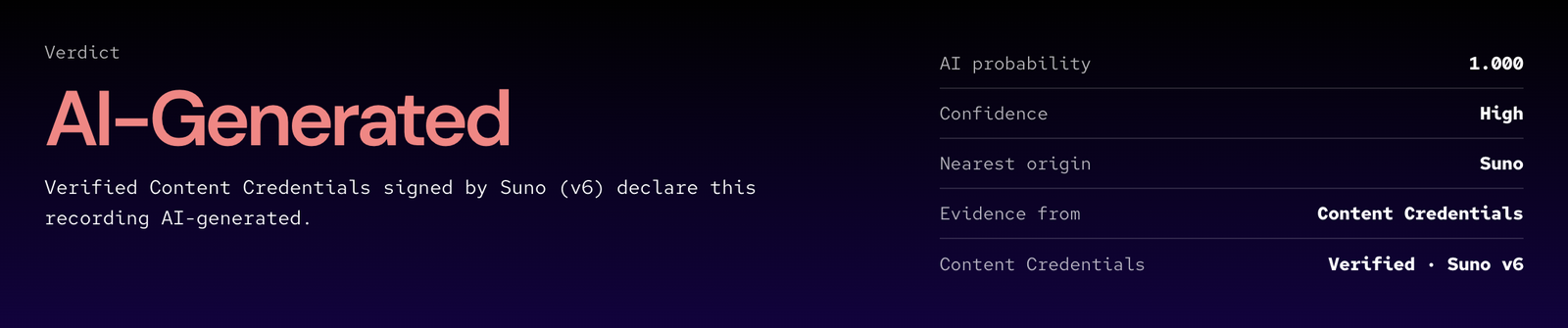
A signed human label is not proof
Recording software has started signing files as well. That signature records which program exported the session. It cannot vouch for every sound imported into it, so a track signed as human-made still goes through full detection.
Where credentials get lost
Credentials survive only in the original exported file. Re-encoding, trimming and most platform uploads strip them, and links to streaming services carry none. The Suno Studio export we tested had no credentials, and Suno's credentials do not say whether a track is a cover.
Most AI music in circulation has no credentials attached, which is why detection still runs on everything else.
In the API and dashboard
API responses include a content_credentials object when the file carries credentials and leave it out when it does not, so existing integrations see no change. The fields are listed in the API reference. In the dashboard, the track report and its PDF show a Content Credentials line.
Accuracy numbers for detection are on the benchmark page.